Why Gas Prices Always End in 9/10 of a Cent
That tiny 9/10 fraction on gas prices isn't accidental. It adds up to thousands in annual revenue for stations and most drivers never notice.
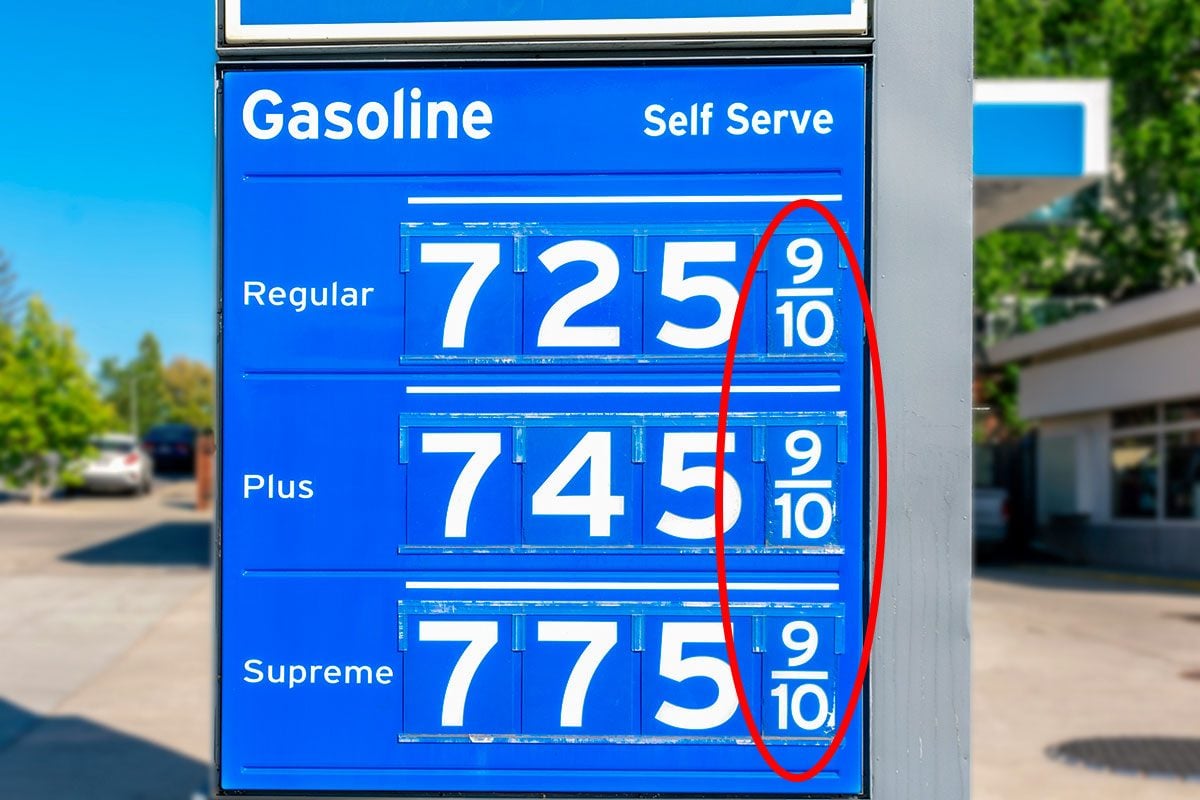
Next time you pull into your neighborhood gas station, take a close look at the sign. That little “9/10” tacked onto the price isn’t an accident, and it isn’t rounding. It’s money, and it adds up faster than most of us realize.
Fuel management specialist Eliot Vancil laid it out plainly. “A single station which fills 300,000 gallons monthly is getting a yearly increase of more than $32,000 on that one sub-cent increment,” Vancil said. That’s $32,000 from a fraction most drivers mentally round away before they’ve even pulled up to the pump. “Retail margins are low, usually five to 15 cents per gallon of regular unleaded,” he told reporters. “So that fraction is not a rounding quirk. It is an intentional line margin which most customers will never consider to inquire about.”
Automotive journalist Michael Satterfield also weighed in on why the practice has stuck around for decades: consumers are simply conditioned to expect it. At this point, stations that try to drop the 9/10 can actually face customer pushback, which sounds strange until you hear what happened in Palo Alto, California, back in 2006.
A retailer there tried an experiment, pricing gas at $2.99 per gallon flat instead of $2.999. Some customers assumed he’d rounded up on them. Others wanted to know why he hadn’t dropped it further. In the end, losing that 9/10 cent on roughly 2,500 gallons sold each day cost the retailer about $23 daily. Small number. Real consequence.
Idaho found out the hard way too.
According to Advancing Convenience & Fuel Retailing, Idaho actually banned fractional pricing in 1985 and levied a $100 fine for stations that kept doing it. That ban lasted four years before the state repealed it in 1989. The market, and the math, won.
So where does this whole thing come from? The practice is called mil pricing, and it traces back to the Coinage Act of 1792. A mil is one-thousandth of a dollar, one-tenth of a cent, and it shows up even now in property tax assessments, utility bills, and stock issuances. It isn’t some quirk of the gas industry. It’s baked into American financial history.
Mil pricing landed at the gas pump because of the Revenue Tax Act of 1932, which set a one-tenth-cent excise tax on every gallon sold. That was the government collecting in mils, so stations priced in mils to pass the cost along cleanly. That federal gas tax has grown considerably since then, sitting at 18.4 cents per gallon now, but the fractional pricing habit it created never went away.
Context matters here. Back when gas cost 20 to 30 cents a gallon during the Great Depression, that 9/10 fraction represented a much bigger slice of the total price. Your family would have noticed it. Today, with prices typically running anywhere from $3 to $5 per gallon depending on where you live and what month it is, the fraction looks small. But small at scale isn’t small. That’s the whole mechanism.
Think about what $32,000 a year means to a single independent station owner working on five to 15 cents of margin per gallon. For a family-owned operation trying to stay competitive against the big chain stations, that sub-cent addition can be the difference between a good year and a rough one. You can check the U.S. Energy Information Administration for current retail gas price data if you want to see how tight those margins really run across regions.
The psychological piece matters too. Retailers everywhere use this logic: $24.99 reads as closer to $24 than $25, even though it’s one penny short of $25. Gas stations get that same effect from the 9/10. Your brain sees $3.59 and ignores the tiny fraction, the same way it rounds $24.99 down to $24. The Federal Trade Commission’s consumer resources have covered how fractional and just-below pricing shapes buying behavior across all kinds of retail, not just fuel.
The next time you’re waiting for the tank to fill up, you can do a quick mental exercise. Take the price you see on the sign, ignore the fraction the way everyone does, and then remember that 300,000-gallon number Vancil put out there. One-tenth of a cent, multiplied across every gallon, every fill-up, every driver who glanced at the sign and mentally rounded down without a second thought, adds up to something that keeps the lights on inside that station.